
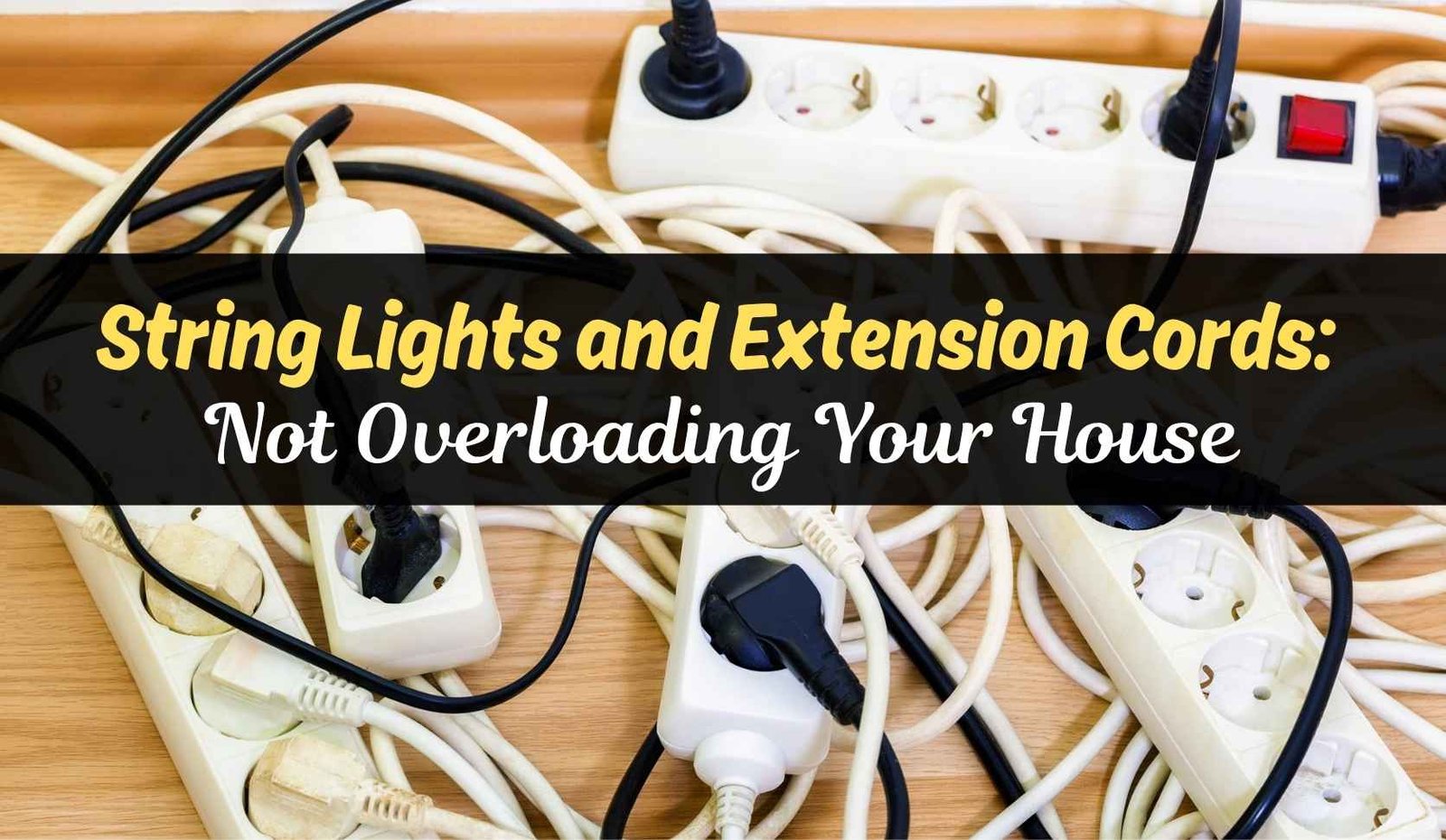
Six strands into one outlet, and a cord under the rug so nobody trips. What the U.S. Fire Administration states about both, and where a host stops and calls a trade.
The setup happens the same way every time. Lights go up, one strand reaches, the second one does not, so an extension cord appears. Then another. Then a power strip, because the extension cord has one socket and there are three things to plug in. Then the cord crosses a doorway, so somebody tucks it under the rug.
Each step is reasonable and the end state is the two things fire authorities name most often: an overloaded outlet and a cord where it should not be.
Quoted verbatim from the U.S. Fire Administration's "Appliance and Electrical Fire Safety" page, read on 2026-08-28. Not softened.
That page does not say when to call an electrician, and this article does not invent a threshold. What it does instead is describe the boundary in terms of what you are being asked to do, which is the last section.
The instruction is clear and it does not come with a figure you can apply, and that is not an oversight. How much a circuit can take depends on the circuit, the house, the wiring and everything else already drawn on it, and none of that is knowable from a web page.
So this article publishes no strand count, no wattage and no amperage. Anyone telling you how many sets of lights you can safely run has not seen your house.
What you can actually work from:
The manufacturer's own instruction. Most light sets state a maximum number of sets that may be connected end to end. That figure is on the packaging or in the leaflet, it is specific to that product, and it is the only number in this whole subject that applies to you. Find it before you start, not after.
Signs that something is wrong now. A plug or outlet that is warm to the touch. A burning or hot-plastic smell. A breaker that trips, once, let alone repeatedly. Lights that dim when something else is turned on. Any of those is a stop, unplug, and do not restart it because it seemed fine afterward.
Fewer things on each outlet. Spreading the load across different outlets in different rooms is the practical version of the rule, and it costs nothing.
The USFA line is two-part: do not overload them, and use ones with internal overload protection.
The second half is the useful buying instruction, because a strip that is just a row of sockets on a cable offers no protection at all. A strip with overload protection cuts out rather than continuing.
The failure mode with strips specifically is daisy-chaining: a strip plugged into a strip plugged into an extension cord. Each link is rated for what it was designed to carry, and a chain gives you all of the length with none of the extra capacity, because the capacity is set by the outlet at the far end.
If a room has one outlet and you need six things plugged in, the honest answer is that the room has one outlet.
"Avoid putting cords where they can be damaged or pinched, like under a carpet or rug" is the one people knowingly break, because a cord across a doorway is a trip hazard and the rug seems to solve it.
It does not solve it. A cord under a rug is walked on repeatedly, has no airflow, and is out of sight, so the damage that develops is damage nobody sees.
Better answers for the same problem:
And the related rule from the same page: replace worn, old or damaged cords right away. Party cords come out of a box once a year, having been coiled tightly and stored, and they are exactly the population most likely to be damaged. Unroll everything fully and look at it before it goes up, not after.
If any part of the run is outside, on a balcony, on a porch, in a garden, then everything in that part of the run has to be rated for outdoor use. Lights, cords, and any strip or timer.
Indoor cords used outdoors are not a smaller version of the same risk; they are a different one, and moisture is the reason. If you cannot confirm from the product's own labeling that it is intended for outdoor use, it is not.
Anything outdoors that burns rather than plugs in is a separate subject with its own authority guidance, and it belongs on the same pre-party pass as everything else a host checks.
This is the boundary, and it is worth stating plainly because the internet is full of pages that walk straight past it.
Plugging things in, choosing a strip, routing a cord, and reading a manufacturer's own limit are householder tasks.
Anything else is not. If the answer to your problem involves adding an outlet, changing an outlet, opening anything, an adapter that changes the plug type, a circuit that keeps tripping, or a run of wiring, that is a licensed electrician's work and this article will not describe it.
The USFA page quoted above does not tell you when to call one. The practical test that does: if the fix involves anything other than what you can plug in and unplug, stop.
That includes the very common party problem of "there is no outlet where the lights need to be". The temporary answer is fewer lights or a different placement. It is not a longer chain of extension cords.
A short pass, and it belongs with everything else on the host's safety checklist.
Only the manufacturer of the set you bought can answer that, and most sets print the figure on the packaging or in the leaflet. This page publishes no strand count, no wattage and no amperage, because how much a circuit can take depends on that circuit, that house, that wiring and everything already drawn on it, none of which is knowable from a web page. Anyone quoting you a universal number has not seen your house. Find the manufacturer's limit before you start rather than after.
The U.S. Fire Administration's wording is to avoid putting cords where they can be damaged or pinched, like under a carpet or rug. The rug looks like it solves the trip hazard, and instead it creates a cord that is walked on repeatedly, has no airflow, and is out of sight, so any damage that develops is damage nobody sees. Route around the edge of the room instead, use a rigid cord cover made for the job, tape it down properly at the edges if it truly has to cross and check it during the evening, or move the thing that needs power rather than moving the power.
Daisy-chaining is the specific failure mode with strips. Each link is rated only for what it was designed to carry, so a chain buys you length and no extra capacity at all, because the capacity is set by the outlet at the far end. The related buying point from the same guidance is to use strips with internal overload protection, since a strip that is only a row of sockets on a cable protects nothing. If a room has one outlet and you need six things plugged in, the honest answer is that the room has one outlet.
By what it is doing, not by arithmetic. A plug or outlet warm to the touch, a burning or hot-plastic smell, a breaker that trips even once, or lights that dim when something else switches on are each a reason to stop and unplug, and not to restart it because it seemed fine afterwards. Touching the plugs and strips an hour into the evening is worth doing deliberately. The cheap preventive version is spreading the load across outlets in different rooms.
At the point where the fix is anything other than what you can plug in and unplug. Plugging things in, choosing a strip, routing a cord and reading the manufacturer's own limit are householder tasks. Adding or changing an outlet, opening anything, an adapter that changes the plug type, a circuit that keeps tripping, or a run of wiring is licensed electrician work, and this article will not describe it. The USFA page quoted here does not set a threshold, so we do not invent one. That covers the classic party problem of no outlet where the lights need to be: the answer is fewer lights or a different placement, not a longer chain of cords.