
Gift-giving stress has four named causes, and research shows givers misjudge what recipients value. Here is the one question that ends the search.
Gift-giving feels stressful because you are being judged on a decision that has no clear right answer, an unlimited number of options, and a real social cost if you get it wrong. Published research adds a second problem: givers consistently misjudge what recipients actually value, so even careful effort can land in the wrong place. The fix is a single question, asked before you shop, that shrinks the whole search down to something you can finish in an evening.
If you have ever stared at a screen for an hour and closed the tab with nothing, this page is the diagnosis and the way out. It sits alongside our full method for how to choose the perfect gift, which is the framework this article is trying to get you calm enough to use.
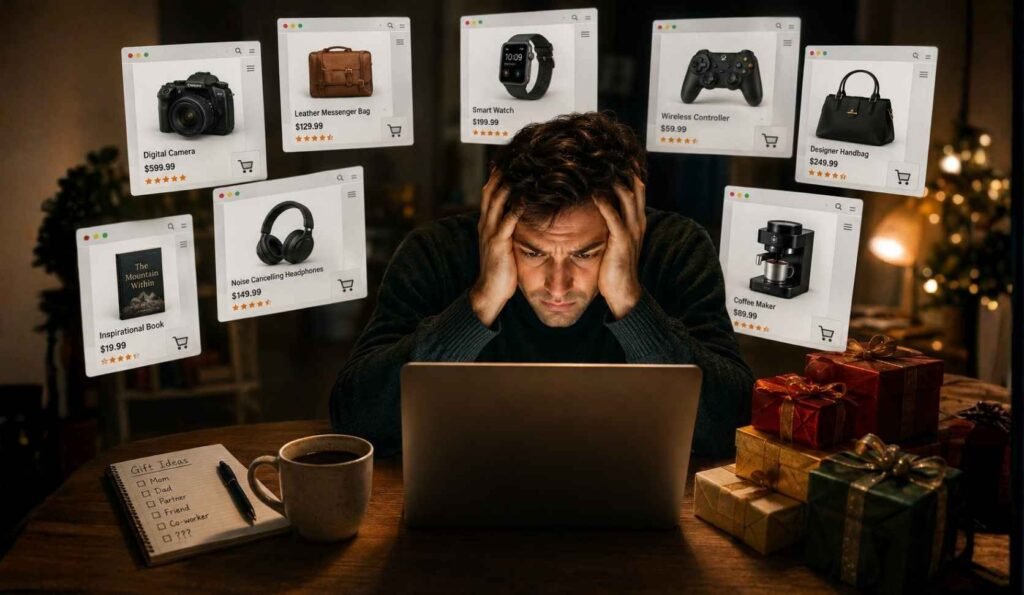
The feeling is common enough to show up in national survey data. In the American Psychological Association’s November 2023 holiday stress survey, conducted online by The Harris Poll among 2,061 US adults, 58 percent of respondents said that spending too much money, or not having enough money to spend, caused them stress during the season. Forty percent named finding the right gifts.
That second number matters more than it looks. Choosing the gift is not a footnote to the money worry. It is a distinct stressor, reported independently, by four in ten adults. Whatever you are feeling, it is not a personal failing or a sign that you are bad at relationships. It is the predictable result of a hard decision made under observation.
The useful move now is to stop treating it as a character problem and start treating it as a design problem. Bad decisions usually come from a bad process, and gift-buying has a famously bad default process: open a store, scroll, hope.
The stress is not one thing. It is four separate pressures arriving at once, which is why generic advice to “relax and have fun with it” never works. Name them and each one becomes smaller.

Almost every other purchase you make has a natural boundary. You need a winter coat, in your size, in your budget, and the field narrows itself. A gift has none of that. Every object made for every person on earth is technically a candidate, and no criterion rules anything out until you supply one.
An unbounded search does not end on its own. It ends when you get tired, which is why so many gifts get bought at 11pm the night before and why so many of them are wrong. The problem is not your attention span. It is that nobody gave the search a stopping rule.
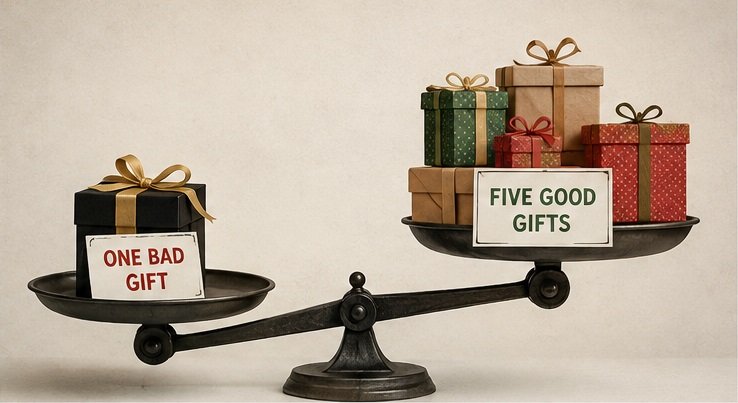
You almost certainly remember a gift that landed badly better than you remember the gifts that landed well. That asymmetry is normal, and it is why the stakes feel so lopsided. A gift that works produces a warm moment that fades. A gift that misses produces a face you replay for years.
Because the downside feels heavier than the upside, the sensible-seeming response is to keep searching for something with no downside at all. No such gift exists. Holding out for it is how a two-hour decision becomes a three-week one, and the extra weeks add anxiety without adding information.
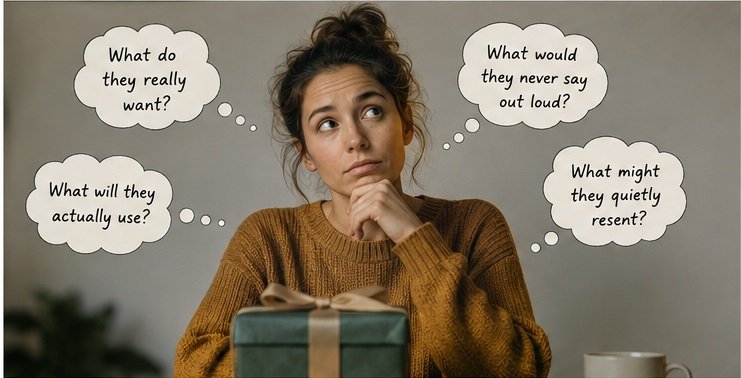
To choose well you have to model another person accurately: what they own, what they want, what they would never say out loud, what they would quietly resent. That is a genuinely difficult cognitive task, and you are doing it with incomplete information about someone whose inner life you can only infer.
Worse, you get almost no feedback. People thank you warmly for gifts they will never use, because that is what politeness requires. So the model in your head never gets corrected, and every year you guess from the same slightly wrong picture.
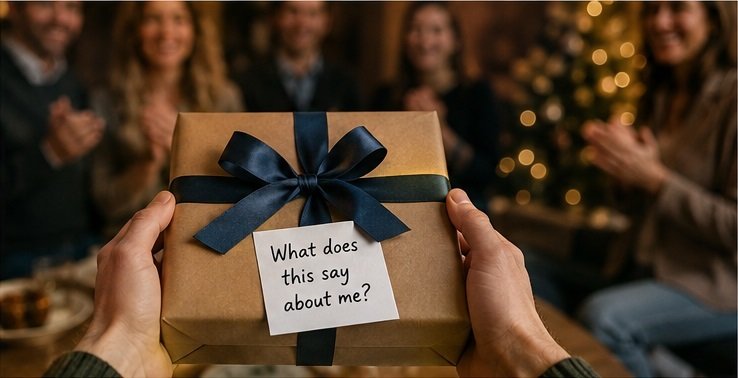
A gift is read as a statement about how well you know someone and how much you value them. That makes it an identity performance, not just a purchase. You are not only choosing an object. You are submitting evidence about the relationship, in front of an audience, to be opened in real time.
This is why the same person who can order groceries in four minutes will agonize for days over a coworker’s birthday. The object is trivial. The claim attached to it is not.
Two published studies explain a great deal of wasted effort, and almost no gift guide mentions either one.
The first is Flynn and Adams (2009), in the Journal of Experimental Social Psychology. Across three studies they found that givers expected a positive relationship between how much they spent and how much the gift would be appreciated, because givers assume a higher price signals more thoughtfulness. Recipients reported no such association. The link that givers were budgeting around did not show up on the receiving end.
The second is Gino and Flynn (2011), in the same journal. Across five studies, recipients were more appreciative of gifts they had explicitly requested than of gifts they had not, while givers assumed both would be appreciated about equally. Givers also expected unsolicited gifts to read as more thoughtful than recipients actually found them.
Put together, the two findings say something uncomfortable and freeing. A large share of gift-giving stress comes from optimizing for things recipients did not report caring about: surprise, and price. We look at what that means for modest gifts in detail in thoughtful vs expensive gifts.
Here it is. Before you look at a single product, ask: what has this person already told me they want?
Not what would impress them. Not what would prove you were paying attention. What have they said, written, linked, complained about, admired out loud, or put on a list. The Gino and Flynn result is that this information is not a shortcut around thoughtfulness. It is the thing recipients appreciate most, and givers systematically under-rate it.
The question works because it converts an unbounded search into a lookup. Instead of imagining every possible object, you are searching a small, real set: things this specific person has already flagged. Most of the time there are two or three candidates and you are done in ten minutes.
It also removes the surprise requirement, which is the single largest source of the stress and, per the research, the thing recipients valued least. Knowing what is in the box does not spoil a gift. It usually improves it.
Sometimes the honest answer is that they have never said. Three moves, in order.
Ask. Directly, casually, in advance. Givers dramatically over-rate how much asking diminishes a gift. Recipients do not experience it that way. A short “anything you have had your eye on?” is not a failure of imagination. It is the method the research supports.
Ask someone closer to them. A partner, a sibling, a close friend usually knows the running list of small wants. This costs you one message and is far more reliable than guessing.
Fall back to a category, not an object. When nobody knows, choose something that does not require knowing: a quality consumable, an experience in a field they already enjoy, or a well-presented gift card to a place they genuinely like. On that last one, see is it rude to give a gift card, because the answer is more encouraging than most people expect.
Sometimes the gift is not the problem. The budget is. In the APA survey above, money was the larger of the two stressors, named by 58 percent against 40 percent for choosing the gift, and the two get tangled because a tight budget makes every choice feel higher stakes.
If that is closer to your situation, the fix is not a better shopping method. It is deciding the total you can genuinely afford before you start, then dividing it across your list. Our guide to how much to spend on a gift works through that in tiers rather than dollar amounts, because the right number depends on your life and not on a national average.
One thing worth saying plainly: if occasion spending is regularly pushing you into debt, that is a financial question and not an etiquette one, and a nonprofit credit counselor is a better source of help than any gift guide.
Most of this stress is recurring and therefore preventable. Two habits do almost all the work.
Keep a running note for the people you buy for most. When someone mentions a want, a complaint, or something they admired, write one line in that note. By the time an occasion arrives you are choosing from a list you already built, in a calm month, from real evidence.
Second, decide the tier before you shop, not while you shop. Anchoring on the first price you see is how budgets quietly break. Setting the tier first is step three of our gift-choosing framework, and it is the step that most reliably ends the doom-scrolling.
For a worked example of the whole method on a specific occasion, see our graduation gift ideas guide, which runs the same decide-then-shop order on a case where the recipient’s next chapter does most of the deciding for you.
A note on scope. This article describes ordinary decision stress. It is not medical or psychological advice. If gift-giving anxiety is part of a broader pattern that is affecting your daily life, please talk to a licensed mental health professional rather than a gift guide.
Yes. In the American Psychological Association’s November 2023 holiday stress survey of 2,061 US adults, 40 percent named finding the right gifts as a source of stress, and 58 percent named money. Gift stress is common, distinct from money stress, and reported at scale, which is a good reason to treat it as a process problem rather than a personal shortcoming.
Because a gift is read as a statement about the relationship, and because the search has no natural stopping point. Every object is technically a candidate until you supply a criterion. Adding a stopping rule, such as choosing only from things the person has already mentioned wanting, ends the overthinking faster than trying to think less.
Not according to the research. Flynn and Adams (2009) found that givers expected higher spending to produce more appreciation, while recipients reported no such association. Price is something givers optimize for and recipients did not report responding to, which is why so much gift-buying effort goes into the wrong variable.
No, and the evidence points the other way. Gino and Flynn (2011) found across five studies that recipients appreciated explicitly requested gifts more than unrequested ones, while givers assumed the two would be appreciated equally. Asking is not a shortcut around thoughtfulness. It reliably produces gifts people like more.
Give the search a boundary before you open a single store. Decide the tier first, then choose only from things the person has already signaled they want. Procrastination on gifts is usually a symptom of an unbounded search rather than a motivation problem, and a search with a stopping rule tends to finish itself.
Sources