

Housewarming gift ideas that land: choose practical or personal by budget tier and relationship, plus gifts to avoid and simple hosting etiquette.
A great housewarming gift does one of two things: it makes the new home more functional from day one, or it adds a personal, welcoming touch that suits the recipient’s taste. Decide which lane fits before you shop. Practical gifts (a starter tool kit, quality kitchen basics, a safety set) are the safest choice for someone you do not know well. Personal gifts (a plant, a signature scent, a framed local print) work best when you already know their style. When in doubt, a consumable like a home-cooked meal or a pantry basket never misses.
Most housewarming guides hand you a list of 55 things and leave the deciding to you. This one flips the order. First you pick a lane, then you choose within it by budget tier and by how well you know the person. That is faster, and it is far more likely to land.

Almost every good housewarming gift sits in one of two lanes, and knowing which lane you are in removes most of the guesswork.
The practical lane is about function. These are gifts that solve a real problem in the first week of living somewhere new: a wall that needs a picture hung, a kitchen missing a decent knife, a bathroom with no bath mat yet. Practical gifts are low-risk because they do not impose your taste on someone else’s home. If you barely know the recipient, start here.
The personal lane is about warmth and identity. These gifts say “this home is yours, and I know you.” A plant chosen for their light, art that reflects where they live, a scent they love. Personal gifts land beautifully when you know the person well, and they fall flat (or worse, feel presumptuous) when you are guessing at someone’s style.
Ask yourself one question: do I know this person’s taste well enough to choose something they will display every day? If yes, the personal lane is open to you. If you hesitate, the practical lane is the honest choice. For the full decision logic behind matching a gift to a person, see our guide on how to choose the perfect gift for any occasion.
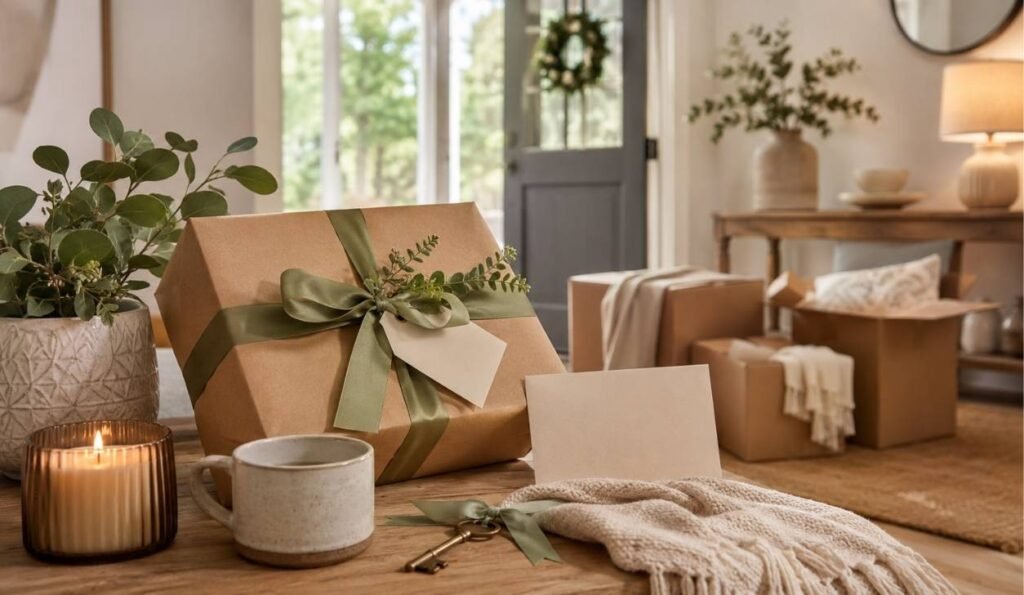
Practical gifts do not need to match the decor, which is exactly why they are safe. Here they are by tier, so you can scale to the relationship and your budget without ever guessing at a price.
Budget tier. A basic tool kit with the essentials (hammer, screwdrivers, tape measure, level, picture hooks), a quality dish towel and pot-holder set, a doormat, a first-aid kit, or a set of good kitchen basics like a sharp paring knife or a wooden spoon set. Small, useful, and immediately in rotation.
Mid tier. A fuller tool set or a cordless drill, a nice cutting board with a knife, a set of matching bath towels, a smart plug or two, a fire extinguisher paired with a small safety bundle, or a set of glassware or dinnerware in a neutral finish. These are the “I would have had to buy this anyway” gifts new homeowners quietly love.
Premium tier. A stand mixer or a quality small appliance, a robot vacuum, a full cookware set, or a professionally framed set of hooks and shelving for a wall they have not figured out yet. Reserve this tier for close family or a shared group gift.
Practical does not mean boring. A well-chosen everyday object in a good material (solid wood, stainless steel, natural fiber) reads as generous, not utilitarian.

Personal gifts carry more meaning and more risk. The rule that keeps them safe: choose something personal to the moment or the place, not something that imposes a specific style on their walls.
Budget tier. A low-maintenance plant matched to their light (a snake plant or pothos for low light, an herb pot for a sunny kitchen), a candle in a clean, widely liked scent, a nice bottle of olive oil or local honey, or a handwritten card with a genuine note.
Mid tier. A framed print or map of their new neighborhood or city, a cozy throw blanket in a neutral tone, a subscription to a coffee or tea of the month, or a nice serving board they can put out when they host.
Premium tier. A commissioned illustration of the house itself, a quality piece of decor you know fits their taste, or an experience tied to the new area (a tasting, a class, tickets to a local venue) that helps them feel at home in the neighborhood.
Notice what these have in common: they lean on the place and the fresh start rather than on your opinion of their interior design. A print of their new city is personal without assuming their color scheme. A monogrammed throw pillow in your favorite shade is not.
When you are unsure of the lane, the taste, or the space, reach for something that gets used up. Consumables are the universally safe housewarming gift because they leave no clutter and demand no shelf space.
Consumables also work when you barely know the host, because nothing about them assumes anything about the person. They welcome without imposing.

Most guides never tell you what to skip. These are the common misfires:
The through-line: a good housewarming gift adds ease or warmth, never a task or an obligation.

Who the recipient is to you should quietly set the lane and the tier.
A close friend or family member. You have earned the personal lane and the higher tiers. Lean into something meaningful, or go in on a premium practical gift as a group.
A coworker or acquaintance. Stay practical or consumable, and keep it mid tier at most. A pantry basket, a nice candle, or a set of kitchen basics is warm without overstepping.
A new neighbor you do not know well. Consumables win. A baked good, a plant, or a small welcome basket introduces you without presuming a friendship that has not formed yet. Keep it modest and genuine.
If you are shopping for a graduate moving into a first apartment, the logic overlaps with a housewarming; see our companion guide on graduation gift ideas for high school and college grads. And for a milestone-year celebrant setting up a new place, our milestone birthday gift ideas by decade pairs well with the practical-versus-personal split above. Both live in our full Gift Guides collection.
A few common-practice norms, framed as customs that vary rather than hard rules:
Bringing a small gift to a housewarming party is common courtesy in most circles, but it is a gesture of goodwill, not an entry fee. If you cannot bring something, your presence and a warm note are enough. When there is no party and someone has simply moved, a gift is a kind touch but not expected.
On timing, gifts are typically given at the housewarming itself or within the first few weeks of a move. If you miss the window, it is still welcome later. And if you receive a housewarming gift, a brief thank-you (a text, a call, or a note) within a week or two is a gracious close to the exchange. Norms differ by region and social circle, so read the room over any strict rule.
What is a good housewarming gift for someone you do not know well?
Stay practical or consumable. A pantry basket, a candle in a widely liked scent, a plant, or a set of quality kitchen basics welcomes them without assuming anything about their taste or their home.
What is a practical housewarming gift?
A practical housewarming gift solves a real problem in the first week of a new home. Think a starter tool kit, sharp kitchen knives, matching bath towels, a doormat, a first-aid kit, or a small safety bundle. These are useful from day one and do not need to match the decor.
Do you bring a gift to a housewarming party?
In most social circles, bringing a small gift to a housewarming party is common courtesy, but it is a goodwill gesture rather than a requirement. Your presence and a warm note are welcome even if you arrive empty-handed.
What should you not give as a housewarming gift?
Avoid gifts that impose your taste (bold wall art, strongly themed decor), highly personalized items when you are unsure of their style, redundant basics they likely bought themselves, and anything that creates a chore, such as a high-maintenance plant for someone who travels often.
What is a good housewarming gift on a budget?
A budget-friendly housewarming gift can still feel generous: a basic tool kit, a quality dish-towel set, a low-maintenance plant, a nice bottle of olive oil or local honey, or a home-cooked meal delivered on moving day. Choosing a good material and adding a genuine note matters more than the amount you spend.