
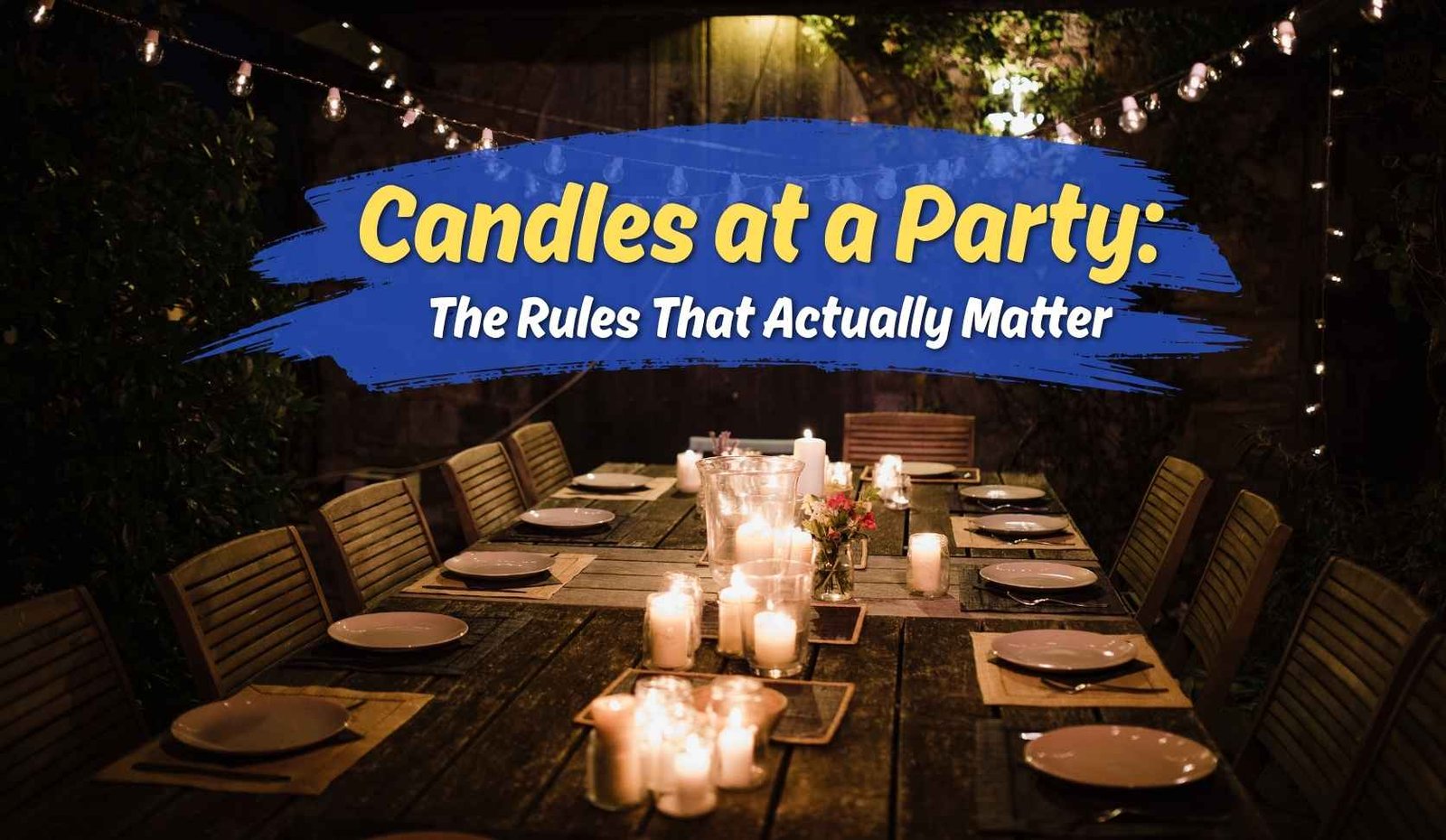
Candles everywhere looks beautiful, and the clearance figure the fire authorities publish is bigger than most tablescapes allow. What USFA states, verbatim.
Candles down the center of a table, on the mantelpiece, in the bathroom, along a windowsill. It is the cheapest way to make a room look like an occasion, and it is also the decoration people put closest to the things most likely to burn.
The fire authorities publish a small number of specific rules for this, and the useful thing about them is that they are specific. They are also stricter than almost any table setting you have seen.
These are quoted verbatim from the U.S. Fire Administration's "Candle Fire Safety" page, read on 2026-08-28. They are not softened here and they should not be softened by anyone.
That is the whole of the official guidance on that page. The rest of this article is what those six sentences mean for a room with twenty people in it.
One note on sourcing. The National Fire Protection Association is the other authority routinely cited on this subject. Our own retrieval of NFPA's candle page on 2026-08-28 returned the page title and not the body, so no NFPA wording is quoted here. That is our failure to obtain the page rather than NFPA withholding anything, and NFPA's own site is worth reading directly.
This is the rule that changes most party setups, and it is worth measuring rather than estimating.
Twelve inches is roughly the length of a sheet of paper. Now look at a typical dinner table centerpiece: candles among foliage, place cards, paper napkins, a menu, a tablecloth that hangs down.
Every one of those is something that burns. So is a paper napkin someone puts down, a card someone props up, a gift bag, tissue paper, dried flowers, a lampshade, and a curtain that moves when a window is open.
Three practical consequences:
A candle in a dense centerpiece almost never meets the clearance. Either the centerpiece gets smaller or the candles come out of it.
The clearance has to hold in every direction, including above. A candle under a low shelf or a hanging decoration is a candle with no clearance overhead.
It has to hold when things move. People put things down. A twelve-inch gap at the start of the evening is not a twelve-inch gap after the second course, and nobody re-measures.
The USFA wording is specific: blow them out when you leave a room, when you leave home, or when you go to bed.
At a party, the room people leave is the one nobody is thinking about. Candles lit in a dining room while everyone moves to another room. Candles in a hallway. Candles in a bathroom, which the same page rules out entirely.
The practical version for a host: candles only in rooms where people actually are. If a room is decorative rather than occupied, it gets flameless.
And there needs to be a point in the evening when somebody walks the whole house and puts them out. That belongs on your own end-of-night list, alongside the other things a host checks before bed: the host's safety checklist is where that sits.
"Stable holders" and "cannot be knocked down easily" are doing a lot of work in a house full of moving people.
What tends to go over: tall thin candlesticks, tea lights on a smooth tray, anything on a surface people lean on, anything at the edge of a table, anything within reach of a coat sleeve, anything at the height of a passing elbow.
Weight and a wide base is the whole test. A holder that is heavy for its size and wider at the bottom than the top is doing the job; a decorative one that looks good and is easy to tip is not.
Height matters as much as base. A candle at standing elbow height in a corridor is in the most collided-with volume of space in a house.
It is worth noticing that "consider using battery-operated flameless candles" is on the authority's own list rather than being a compromise somebody invented.
For a party specifically, they solve the two hardest problems at once: the room nobody is watching, and the surface nobody is thinking about. Flameless candles in the hallway, the bathroom, on high shelves and among any decoration that cannot meet the clearance, with real flame reserved for a small number of places you can actually supervise, is a setup that survives an evening.
It is also the answer wherever children or pets are moving around, because it removes the question entirely rather than managing it. Which rooms are open, which are closed and where a real flame is permitted are host decisions made before the first guest arrives, alongside everything else on the host's safety checklist.
Tablecloths and runners. A cloth that overhangs is fabric that moves, and a guest standing up can pull the whole surface a few inches.
Anything dried. Dried flowers, dried foliage, pampas grass, wreaths. These go up faster than people expect and they are exactly what gets arranged around candles.
Alcohol near flame. Spirits are flammable. A candle beside a drinks table is worth moving on that basis alone.
Drafts. An open window or a door that gets propped changes the airflow, and a flame that was steady starts leaning toward something.
Candles in glass containers. Contained flame is safer in one respect and the glass gets genuinely hot, which matters when it is passed, moved, or picked up by someone who has been drinking.
Guests lighting their own. Somebody will. Decide where the matches and lighters live, and it is not on the table.
It is not a fire safety course, and it does not restate the parts of one that belong to a fire service.
Anything about detection, alarms, extinguishers or evacuation is your local fire service's, and worth asking them about. Many will advise householders directly. This page covers a decorating decision, and the decorating decision is the part a host controls.
If a candle problem is already happening rather than being prevented, that is not a reading situation. Emergency services, immediately.
Twelve inches, which is the U.S. Fire Administration's own wording: keep candles at least 12 inches away from anything that burns. That is roughly the length of a sheet of paper, and it has to hold in every direction, including above, so a candle under a low shelf or a hanging decoration has no clearance overhead. It also has to hold once the evening starts moving, because a napkin, a card or a gift bag put down next to a candle closes the gap and nobody re-measures. In practice a candle inside a dense centerpiece almost never meets it, so either the centerpiece gets smaller or the candles come out of it.
No, not lit ones. The USFA page states plainly that lit candles do not belong in bedrooms, bathrooms and sleeping areas, and a party does not change that. Those are also the rooms most likely to be empty for long stretches, which collides with the second rule on the same list. Flameless candles are the substitute the authority itself names.
That is what the guidance says: blow them out when you leave a room, when you leave home, or when you go to bed. A party is the hardest place to keep that rule, because the room people drift out of is exactly the one nobody is thinking about. The workable host version is to light real flame only in rooms where people actually are, give decorative rooms flameless candles instead, and set a point in the evening when somebody walks the whole house and puts everything out.
They are on the authority's own list, not a substitute somebody invented: the USFA guidance says to consider battery-operated flameless candles, which can look, smell and feel like real ones. For a host they solve the two hardest problems at once, the room nobody is watching and the surface nobody is thinking about. Use them in hallways, bathrooms, high shelves and any arrangement that cannot make the twelve inches, and keep real flame for the few places you can supervise. Where children or pets are moving around, they remove the question rather than managing it.
Six things, and none of them is the candle itself. An overhanging tablecloth or runner moves when a guest stands up. Dried flowers, dried foliage and wreaths burn faster than people expect and are exactly what gets arranged around candles. Spirits are flammable, so a candle beside the drinks table is worth relocating. A propped door or open window changes the airflow and a steady flame starts leaning. Glass containers get genuinely hot, which matters once they are being picked up and moved. And somebody will light their own, so decide where the matches and lighters live, which is not on the table.