Everyone wants sparklers for the photo. What the U.S. Fire Administration publishes about the temperature they reach, and what it recommends instead.
Sparklers are the one everybody underestimates, because they are handed to children, sold in supermarkets, and used in photographs at weddings. They read as decorative rather than as fire.
The U.S. Fire Administration publishes a figure that makes the point better than any argument would.
From the U.S. Fire Administration's "Outdoor Fire Safety" page, read on 2026-08-28:
"Sparklers can reach 1,200 degrees F and cause third-degree burns."
That is not softened here and it should not be softened anywhere. A sparkler is not a small firework; it is a metal rod at a temperature that will burn through clothing and cause a full-thickness burn, held in a hand, frequently a child's, frequently at night, frequently at a party where people have been drinking.
Also quoted verbatim from the same page:
"Fireworks are dangerous to people and pets. Using them puts your property at risk. The best way to stay safe from fireworks is to not use them. Instead, attend a public fireworks displays put on by professionals."
That is the authority's own recommendation and it is unambiguous, so this article will not spend the next section quietly working around it. The safest thing a host can do about fireworks at a private party is not have them.
What follows is for the situation where a host is going to make a different decision anyway, because a page that ends at "don't" is a page nobody reads to the end.
Whether consumer fireworks or sparklers are legal where you live varies by state and by municipality, and this article asserts nothing about what is permitted anywhere.
That is not evasiveness. Rules differ between neighboring towns, they change, they differ by date and by product type, and a page that told you it was fine would be wrong somewhere.
Two places to actually get the answer: your state fire marshal's office, and your local fire department, both of which publish this and both of which will answer a question. Your city or county may also have its own ordinance. Ask before you buy, because buying something legally in one place does not make it legal to use in another.
If you rent, or live under a homeowners' association or a building management arrangement, that is a third set of rules and it is usually stricter than the law.
Assuming you have established they are permitted and you have decided to go ahead, these are the things that reduce harm. None of them makes a 1,200 degree object safe.
Adults only, with no exceptions negotiated on the night. Sparklers are marketed at children and the temperature figure above is the reason to decline that framing. If children are present, the decision is easier: no sparklers.
One at a time, one person at a time. The injuries happen in crowds, when someone turns with a lit sparkler in their hand.
Outdoors, always. Well away from the house, from anything overhanging, from decorations, and from anywhere people are seated.
Nothing loose, nothing flowing. Long sleeves, scarves, veils, costumes and anything trailing are the specific clothing risk.
A bucket of water or sand, ready before the first one is lit. Spent sparklers go straight into it, tip first. A discarded sparkler stays hot long after it has stopped sparking, and the burns that happen at the end of the evening are from ones on the ground.
Not near anyone who has been drinking, which at a party is a real constraint rather than a theoretical one. This is a judgment a host has to make about their own guests, and it is easier to make before the evening starts than during it.
Not near pets, which USFA names explicitly in its own sentence above. The practical version is that animals are indoors, in a closed room, before anything is lit.
Nobody holds one for a photograph while looking at the camera. That is the single most common way the person holding it stops paying attention to what is in their hand.
The same USFA page covers open fires outdoors and its rules are specific:
Ten feet from the house and from anything that burns is a bigger clearance than most patios allow, which is the same discovery hosts make about candle clearance indoors. Measure it rather than estimating, and remember that "anything that can burn" includes a fence, a shed, a hedge, garden furniture, a parasol and the decorations you just put up.
The last rule is the one that gets skipped at a party, because the fire is still going when the guests leave and nobody wants to be the one to end it. It is a host's job and it goes on the end-of-night list, alongside everything else on the host's safety checklist.
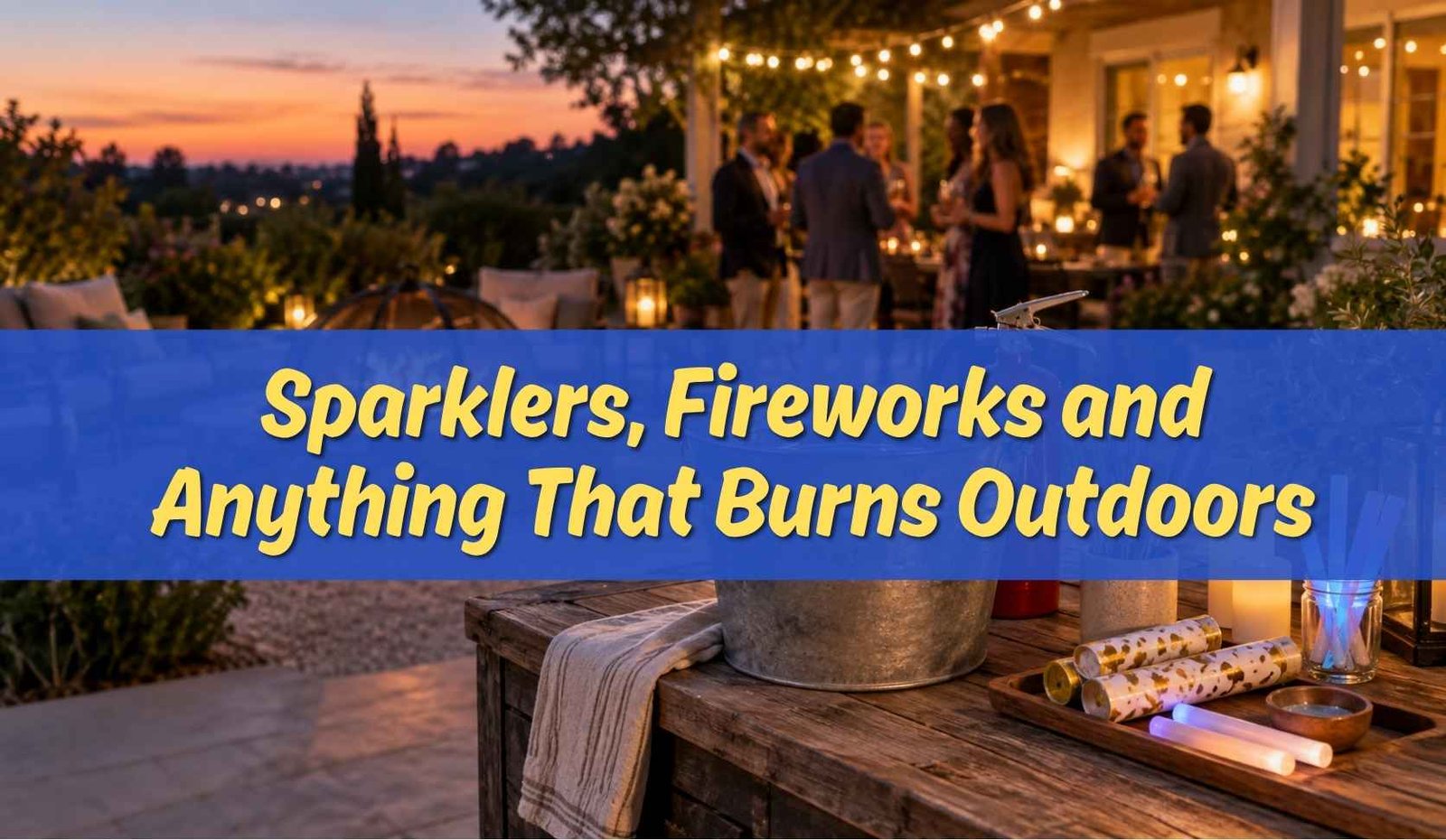
The reason sparklers persist at events is a picture, and there are ways to get the picture.
LED sparkler sticks exist and photograph reasonably in a group shot, particularly in a video.
Confetti, ribbons or a paper send-off for the moment where people line up. The shot is about the line and the movement, not about the flame.
A professional display, which is what USFA's own guidance points at.
Lighting, done properly. String lights, uplighting, or lanterns produce the atmosphere people are actually after, and they do it for the whole evening rather than for ninety seconds.
Flameless candles, which the same authority names in its indoor guidance as a real option rather than a compromise.
It is not a fireworks guide and it will not tell you how to set up a display, how far to stand back from a specific product, or how to handle a misfire.
Anything beyond a hand-held sparkler is a subject for the people who regulate and attend fires, and the honest answer is the one USFA gives: attend a professional display instead.
If something is burning that should not be, that is not a reading situation. Emergency services, immediately.
The U.S. Fire Administration states that sparklers can reach 1,200 degrees F and cause third-degree burns. We quote that unsoftened because it is the whole argument. A sparkler is not a small firework, it is a metal rod at a temperature that burns through clothing and causes a full-thickness burn, and it is usually held in a hand, at night, at an event where people have been drinking.
The temperature figure above is the reason to decline the way sparklers are marketed. This page's position is adults only, with no exceptions negotiated on the night, and if children are present at all the simpler decision is no sparklers. The same USFA page also says to watch children closely whenever a fire pit is in use, which is the other place the question comes up outdoors.
That varies by state and by municipality, and this page asserts nothing about what is permitted anywhere. Rules differ between neighboring towns, change over time, and differ by date and product type, so any page telling you it is fine is wrong somewhere. Ask your state fire marshal's office and your local fire department, both of which publish this and will answer a question, and check whether your city or county has its own ordinance. Ask before you buy, because buying something legally in one place does not make it legal to use in another. If you rent or live under a homeowners' association, that is a third set of rules and it is usually stricter than the law.
The USFA guidance is at least 10 feet from your home or anything that can burn for chimneys, outdoor fireplaces and fire pits, and at least 25 feet from tents, shrubs and anything that can burn for campfires. Ten feet is a bigger clearance than most patios allow, so measure it rather than estimating, and count the fence, the shed, the hedge, the garden furniture, the parasol and the decorations you just put up as things that can burn. The same guidance asks for a metal screen over wood-burning fires to keep sparks in, and for the fire to be out before you leave the yard, which is the rule a party skips because nobody wants to end it.
The picture is the actual reason sparklers persist, and it is available without them. LED sparkler sticks photograph reasonably in a group shot and especially on video. Confetti, ribbons or a paper send-off works for the moment where people line up, because that shot is about the line and the movement rather than the flame. A professional display is what the USFA guidance points at. Proper lighting, string lights, uplighting or lanterns, gives you the atmosphere for the whole evening instead of for ninety seconds, and flameless candles are named by the same authority as a real option rather than a compromise.