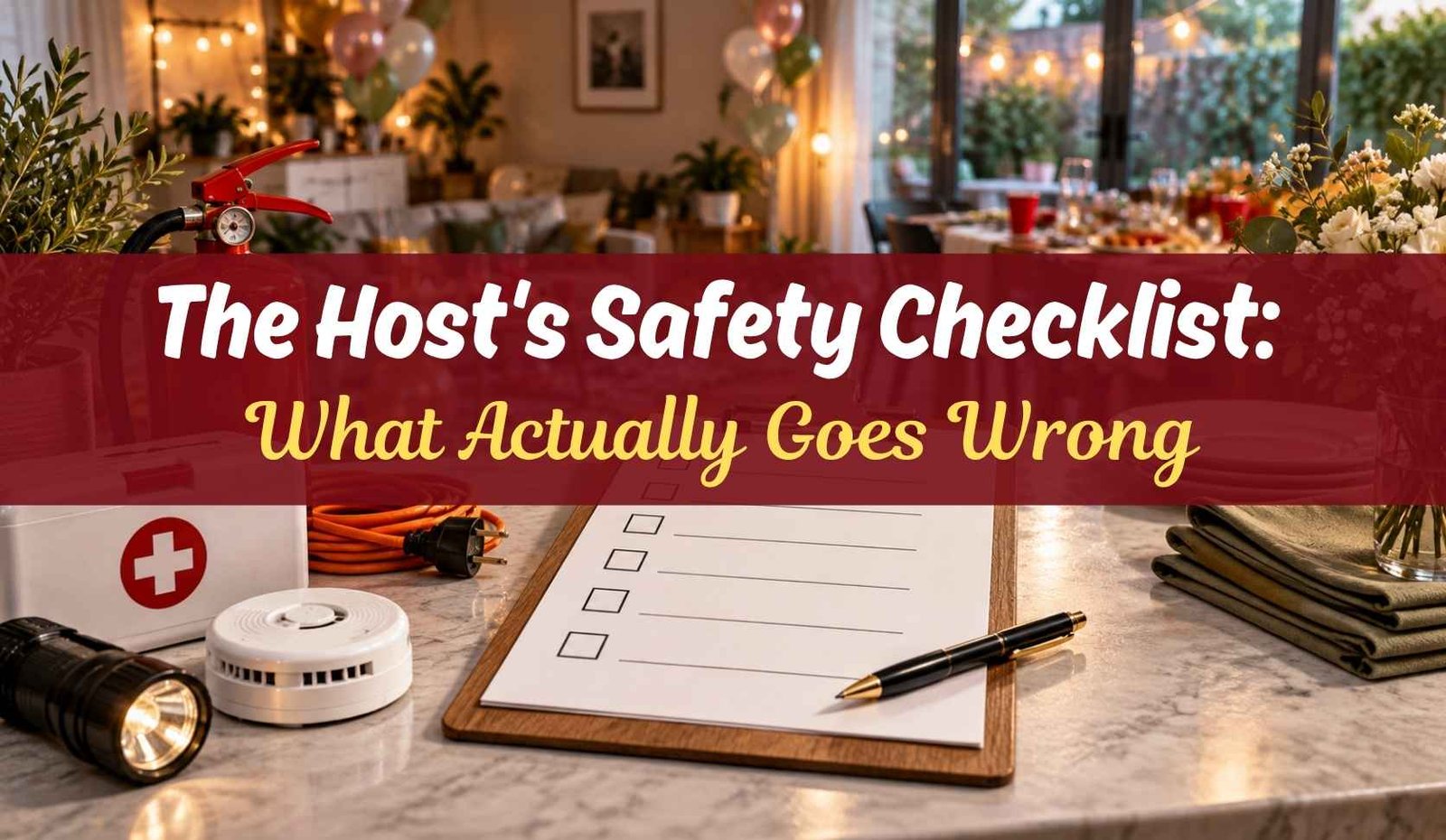
A party safety checklist for hosts built on what named authorities publish, not on scare copy. Candles, cords, doors, small children, and the numbers we refuse.
Twenty people in a house that was built for four is not a dangerous situation. It is an ordinary one with more moving parts than usual, and almost everything that goes wrong at a home gathering comes from the same short list: an open flame near something that burns, too many things in one outlet, a door nobody is watching, food left out too long, and a guest who should not be driving.
This page is the hub. It says what the named authorities actually publish, refuses the numbers nobody has published, and points at the trade or the source that owns each question we cannot answer. It describes mainstream US practice and US authorities, which are not universal.
Walk the route a guest will take: front door, coat, drinks, food, bathroom, back out again. Most of the checklist is visible from that walk.
Candles get their own section because the guidance is specific, free, and almost never quoted properly.
The US Fire Administration, part of FEMA, publishes these rules on its candle fire safety page:
Twelve inches is the figure to work to, and it is a bigger distance than a table centerpiece usually allows. Measure it once with your hand and you will see why the rule exists. The USFA page also states that "on average, 20 home candle fires are reported each day," attributing the figure to the National Fire Protection Association. The page does not print the years that average covers, so neither do we.
Two host-specific notes on top of that guidance. A party is exactly the situation the "blow them out when you leave the room" rule was written for, because the room empties and refills all evening and nobody is appointed to watch. And the bedroom rule collides with the coat pile: if coats are going on a bed, there is no candle in that room.
Decorative lighting is where a host is most likely to improvise, and improvising with electricity is the part of this list that ends worst.
The rules that do not require a source, because the product supplies them:
And the line this page does not cross: anything involving the fixed wiring of the house is a licensed electrician's work. If you are looking at the outlet itself, at a warm faceplate, at a breaker that trips when the lights go on, or at the idea of adding an outlet before the weekend, that is the point to stop and call one. There is no version of that job that is a party preparation task.
Food timing and temperature is a real hazard at a gathering, and it is the one part of this checklist where we are publishing no figure today.
The reason is worth stating plainly, because it is how this site works. The US authorities on this are the USDA Food Safety and Inspection Service and FoodSafety.gov, and both pages refused our automated request when we went to read them on the day this was written. We are not going to reproduce a temperature range or a time limit from memory or from a page that is summarizing them. Go to FoodSafety.gov directly, and treat the timing and temperature rules there as the ones that govern your buffet table.
What we can say without a figure is structural. Food that came out of a refrigerator and is sitting on a table is on a clock, the clock runs faster in a warm room, and the practical host's answer is to put out half and refill from the refrigerator rather than putting everything out at the start. That way the clock restarts instead of running all evening.
Fifteen adults, four toddlers, and the adults are all facing each other. That is the actual hazard, and it is a supervision problem before it is an equipment problem.
The host's job here is smaller than the internet suggests and more awkward than the internet admits. It is to make sure a guest who should not drive does not drive, and to make that easy rather than confrontational.
The practical version is a decision made before anyone arrives, not during: a couch, a rideshare, a spare bed, a lift from someone who is not drinking. Offering an arrangement that already exists is much easier than proposing one at midnight.
What this page will not do is tell you what your legal exposure is. Host liability for a guest's drinking varies by US state, and it is not a question a national article can answer for your address. If that is a live concern for you, ask someone qualified in your state. We assert no legal position.
The host's part of the pet question is about the room. Where does the animal go while the front door is opening every ten minutes. Who knows the animal is behind that door. Are guests being told not to feed it. Is there a quiet space away from the noise.
Everything about the animal's body is somewhere else, and this is a hard line rather than a stylistic one. If the question is whether a food, a plant or a decoration is harmful to an animal, or what to do because an animal has eaten something, that is a veterinary question and this site has no veterinary authority whatsoever. Ask your own veterinarian, or an emergency veterinary service. We will not guess, and a page that guesses about this is worse than a page that says nothing.
Three questions come up constantly and get answered on other sites with a confidence nobody has earned. Here is why they are not answered here.
"How many people is too many for this room?" Occupancy limits are set for assembly buildings by codes that do not govern a private home, so there is no national number for a living room, and anyone printing one made it up. The host's version of the question is better anyway: can two people pass each other on the route to the door, is the second way out clear, and can you get from the kitchen to the front door without turning sideways. If any of those is a no, the room is full.
"How far should the fire pit be from the house?" There is a real answer and it is local. Outdoor burning distances are set by municipalities and fire districts, they differ, and some places prohibit it outright. Ask yours.
"Are sparklers legal?" Also local, also genuinely variable across US states and municipalities, and a national page asserting an answer is wrong somewhere.
Refusing those three costs nothing and is the reason you can trust the twelve inches in the candle section, which is a real published number from a named federal source.
Twelve inches. The US Fire Administration publishes "keep candles at least 12 inches away from anything that burns" on its candle fire safety page, along with blowing them out when you leave the room, using stable holders where they cannot be knocked down, and keeping lit candles out of bedrooms and sleeping areas. Two of those rules matter more at a party than on an ordinary evening: the room empties and refills all night with nobody appointed to watch the flame, and if the coats are going on a bed, there is no candle in that room.
There is no national number for a living room. Occupancy limits are written for assembly buildings under codes that do not govern a private home, so a figure printed for a house was invented by whoever printed it. The host's version of the question is more useful: can two people pass each other on the route to the door, is the second way out clear, and can you get from the kitchen to the front door without turning sideways. If any of those is a no, the room is full.
This page takes no legal position, because host liability for a guest's drinking varies by US state and no national article can answer it for your address. If it is a live concern, ask someone qualified in your state. What the host can control is practical and it is decided before anyone arrives: a couch, a spare bed, a rideshare, or a lift from someone who is not drinking. Offering an arrangement that already exists is far easier than proposing one at midnight.
Four, and the product supplies all of them. Follow the light set's own instructions for how many sets may be connected end to end, because that number is the manufacturer's and it differs between products. Read the rating printed on the extension cord rather than picking a cord for its length. Keep indoor cords and light sets indoors, since outdoor use is a separate rating and it is marked. Run nothing under a rug or through a door that closes on it. Then stop at the fixed wiring: a warm faceplate, a breaker that trips when the lights go on, or adding an outlet is a licensed electrician's job, not a party preparation task.
Because the two US authorities on it, the USDA Food Safety and Inspection Service and FoodSafety.gov, both refused our automated request on the day this was written, and we will not reproduce a temperature range or a time limit from memory or from a page summarizing them. Go to FoodSafety.gov and treat what it publishes as the rule for your table. The structural advice holds without a figure: food out of the refrigerator is on a clock that runs faster in a warm room, so put out half and refill from the refrigerator instead of setting everything out at the start.
Sources, read on 2026-09-02
Not reached, and named so you can go there yourself: USDA Food Safety and Inspection Service and FoodSafety.gov (food timing and temperature) and cpsc.gov (the balloon label wording) both refused our automated request on the day of writing. No figure from either has been reproduced from memory or from a secondhand summary.