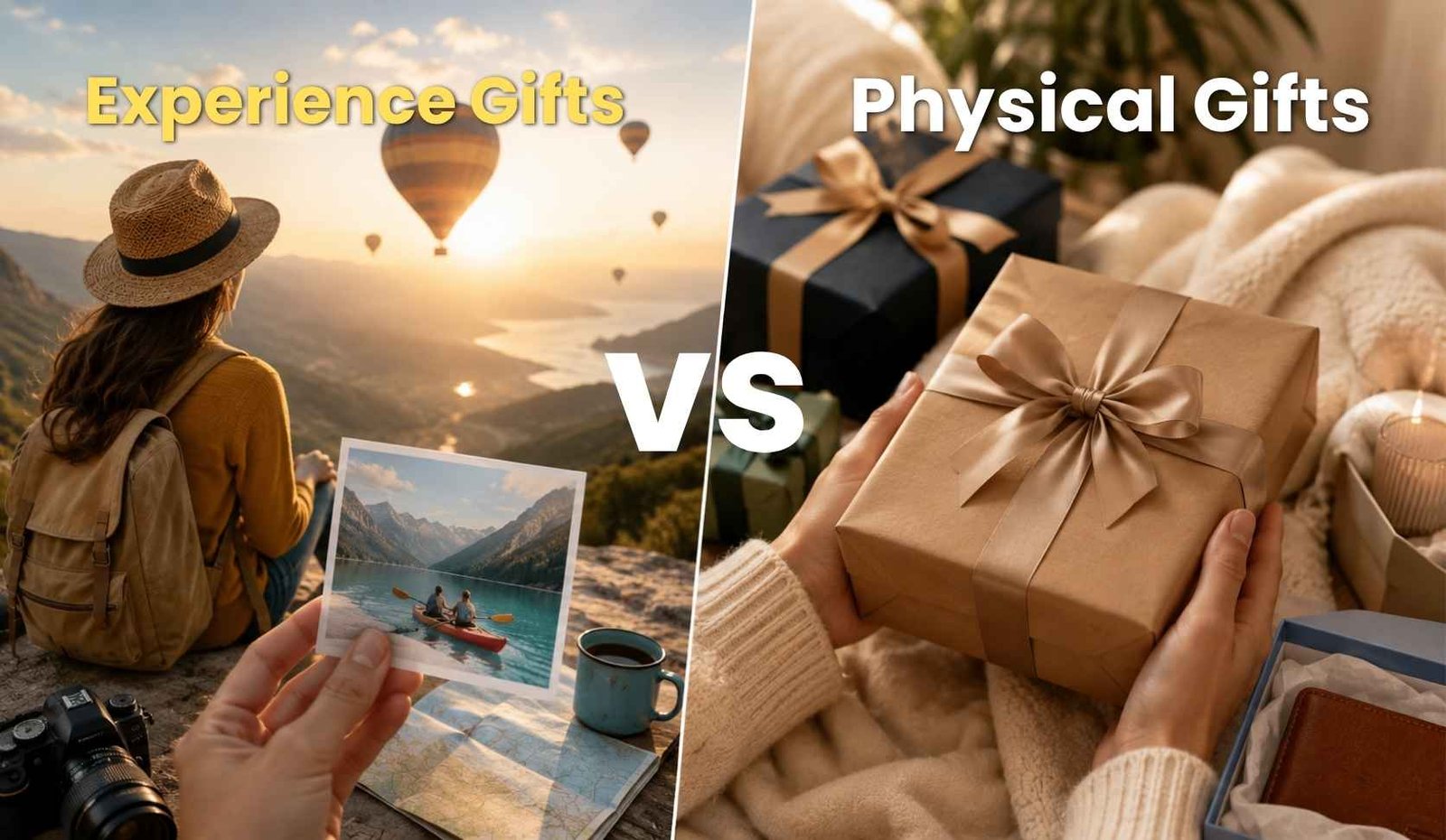
Experience gifts win in the research, but not for everyone. The five cases where an object is the better gift, and the question that decides it.
Research consistently favors experience gifts, and the practical answer is still “it depends on the person.” Published studies find that people report more lasting happiness from experiences than from possessions, and that experiential gifts strengthen the relationship between giver and recipient more than material ones of similar value. But an experience gift asks something of the recipient that an object does not: time, scheduling, and often physical or social effort. So the useful question is not which type is better on average. It is this: does this person lack things, or lack time? Give an experience to someone with room in their calendar and enough stuff. Give an object to someone whose calendar is the scarce resource.
This page covers what the research actually says, the five situations where an experience gift is the wrong call, and how to build a gift that does both jobs.
Two studies get cited constantly, usually without their limits attached. Here is what each one says.
Van Boven and Gilovich (2003), “To Do or to Have? That Is the Question,” Journal of Personality and Social Psychology. When people reflected on their own past purchases, experiential purchases were reported as making them happier than material ones. The proposed reasons: experiences are more open to positive reinterpretation over time, they are more central to a person’s sense of identity, and they have more social value because they are worth talking about.
Chan and Mogilner (2017), “Experiential Gifts Foster Stronger Social Relationships Than Material Gifts,” Journal of Consumer Research. Studies of real gift exchanges found that experiential gifts produced greater improvement in relationship strength than material gifts, and, importantly, this held whether or not the giver was present for the experience. The mechanism the authors identify is the intensity of emotion the recipient feels while using the gift, not when opening it.
Two things follow from that second finding that most coverage skips. First, the relationship benefit arrives later, at the moment the experience happens, which means an experience gift that never gets used delivers nothing at all. Second, you do not have to insert yourself into the experience for it to work.
Both papers describe averages across groups, mostly in Western samples, and neither claims that experiences beat objects for every person in every situation. The exceptions are the useful part.
Ask: what is this person short of?
| The recipient is short of | Give | Why |
|---|---|---|
| Things (a new home, a new job, a fresh start, a graduate) | An object | The practical gap is real and an experience does not close it |
| Time (new parents, carers, people working long or unpredictable hours) | An object, or a service that returns time | An experience adds a scheduling obligation to a life with no slack in it |
| Space (a downsizing parent, a minimalist, someone in a small apartment) | An experience or a consumable | An object is a storage problem in a nice box |
| Novelty (someone who owns everything they want) | An experience | Objects have stopped registering; a memory has not |
| Rest (someone recovering, grieving, or exhausted) | A consumable, a service, or an object | An experience becomes homework at the exact moment they have none spare |
This is the same logic our guide to how to choose the perfect gift applies across every occasion: start from the person’s actual constraints, not from the category you like.
Every page selling experience gifts skips this section. It is the one worth reading.
1. When it is really an obligation with a deadline. A voucher with an expiry date is a task on the recipient’s to-do list. If it expires unused, you have given them a small, dated failure. Prefer bookings you have already made, or open-ended memberships, over vouchers that must be redeemed by a certain date.
2. When the recipient’s calendar is not their own. New parents, shift workers, carers, people with unpredictable jobs. “Book a weekend away” assumes a weekend exists. For these recipients, an object or a service (a cleaning, meals, hours of childcare you personally provide) is far more generous than an outing they will have to postpone twice and then cancel.
3. When the experience requires abilities or circumstances you assumed. Hikes, high ropes, spa treatments, long drives, loud venues, alcohol-based events, anything requiring stamina or standing. Disability, chronic illness, pregnancy, sobriety, sensory sensitivity and social anxiety all turn a “fun” experience into an awkward decline. If you would need to check first, you probably need to check first.
4. When the experience costs the recipient money. Travel to the venue, parking, meals, a babysitter, the outfit, the tip, the upgrade the voucher does not cover. An experience gift can quietly hand someone a bill. It is a real failure mode and nobody in the business of selling experiences mentions it.
5. When the occasion calls for something that lasts. Some moments want a permanent object: a milestone birthday, a retirement, a birth, a memorial. A keepsake stays in the room afterwards. Our guide to milestone birthday gifts covers occasions where a physical marker is doing a job an outing cannot.
The research finding is not “objects are bad.” Objects win when:
The strongest gifts often refuse the binary. The pattern: give a physical thing that starts an activity.
Cooking equipment paired with the class you booked. A camera plus a day out to use it. Seeds and tools with an afternoon spent planting them. A book with two tickets to hear the author. Boots plus a walk you have planned together.
This gets you both mechanisms: the object is there on the day and keeps signaling afterwards, and the experience is what the recipient will actually remember. It also solves the presentation problem that experience gifts have, which is that an email confirmation is a poor thing to unwrap.
The Chan and Mogilner finding puts the value at the moment of use, so getting it used is the whole job.
Presentation is doing a lot of the work in all of these, which is the same point our guide to personalizing a gift makes: specificity and delivery often matter more than the category or the amount you spent, a theme our guide to how much to spend on a gift picks up from the money side. If time is short, an experience is also one of the few formats that still works on the day, as our last-minute gift guide explains.
The research above is drawn largely from US and other Western samples, and the framing of gifts as tools for personal happiness is itself culturally specific. In many traditions the correct gift at a given occasion is set by custom rather than chosen to suit the recipient’s personality, and an unconventional experience gift can read as a departure from the form rather than a thoughtful gesture. If you are giving across a cultural line, the local convention outranks any research finding.
On average, in the published research, yes. Van Boven and Gilovich (2003) found people reported greater happiness from experiential purchases than material ones, and Chan and Mogilner (2017) found experiential gifts improved relationship strength more than material gifts. Both describe group averages, not rules for individuals, and both were conducted largely in Western samples.
When the recipient is short of time rather than short of things, when they need something practical (a new home, a new job, a first apartment), when the occasion calls for a lasting keepsake, or when an experience would require ability, travel or scheduling you cannot assume they have.
They can expire, and they can quietly cost the recipient money. A dated voucher becomes a chore, and travel, parking, meals and childcare are often not covered. Booking the thing yourself and removing the surrounding costs fixes most of it.
Give something physical connected to it: a printed booking in a card, a small related object, a photo of the place. The Chan and Mogilner research locates the emotional payoff at the moment the experience happens rather than when it is opened, so the wrapping is there to make the giving moment feel complete.
No. The research found experiential gifts strengthened the relationship whether or not the giver joined in. Include yourself when they would genuinely want your company, and be honest with yourself if the outing you picked is the one you wanted.
Sources