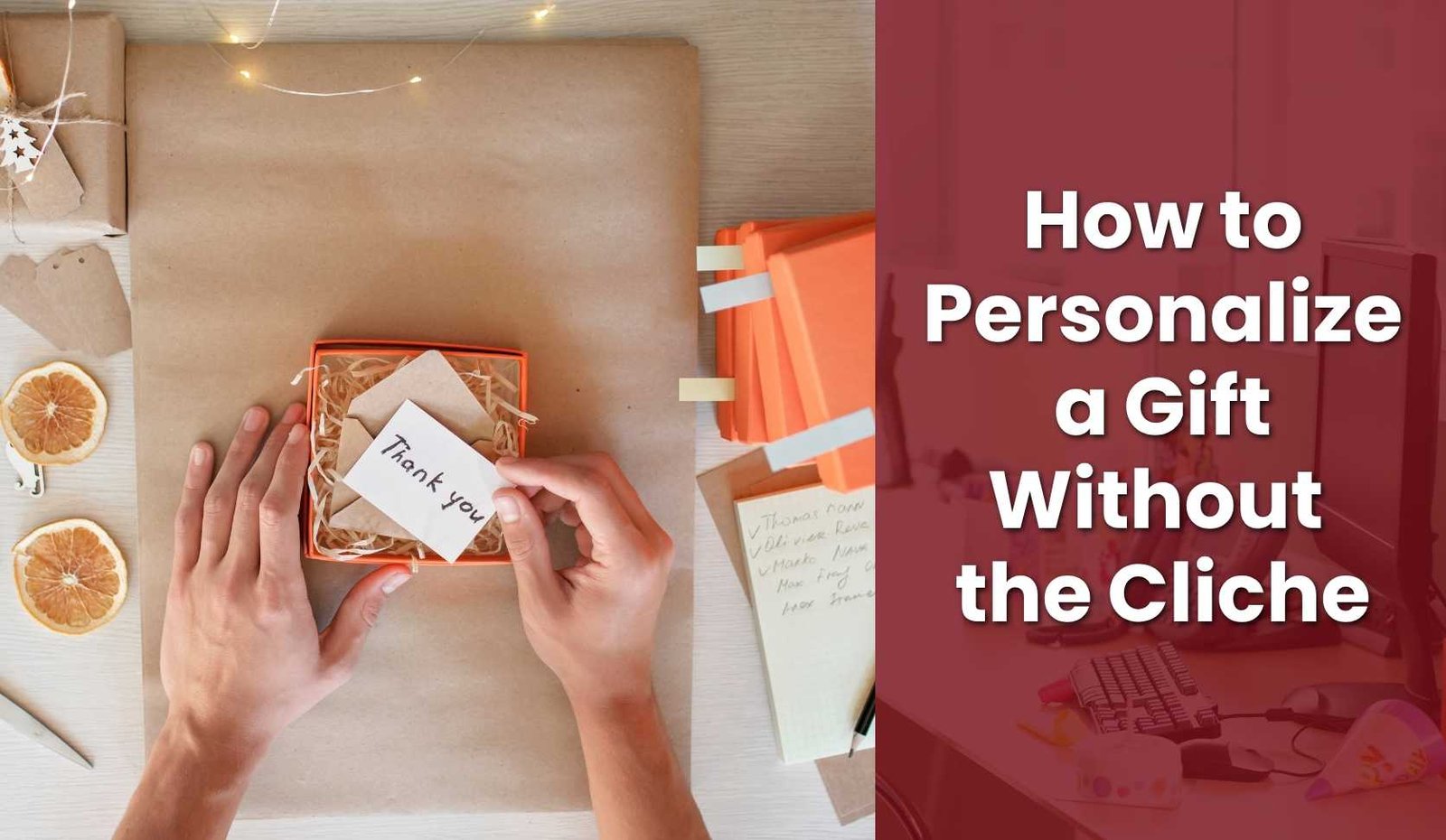
Personalizing a gift is not the same as printing a name on it. The test that separates real personalization from monogrammed filler, and when to skip it.
To personalize a gift properly, apply one test before you buy anything: would this gift still make sense for another person with the same initials? If yes, you have not personalized it, you have labeled it. Real personalization comes from a specific piece of knowledge about the recipient (a habit, a date that matters to them, an inside reference, a problem they keep complaining about) rather than from printing their name on a standard object. Monograms, photos and engraved dates are the surface layer of personalization. They are fine. They are not the thing that makes a gift land.
That distinction is the whole article. If you want the broader decision method first, our guide to how to choose the perfect gift sets out the framework this page plugs into.
Search for personalization advice and you land almost entirely on print-on-demand storefronts: photo services, monogram shops, custom-print platforms. That is not a conspiracy, it is just what is easy to sell. A name is the only variable a company can take from a form field and apply to any object in the catalog.
So the industry definition of personalization is: the same product, with your text on it. The recipient's definition is different. To them, a gift feels personal when it proves you were paying attention. Those two definitions overlap sometimes, and confusing them is why so many personalized gifts feel oddly hollow.
Think of it as a ladder. Each rung requires more knowledge of the recipient and delivers more of what personalization is supposed to do.
| Level | What it is | Example of the logic | What it proves |
|---|---|---|---|
| 0. Marking | Their name, initials or a photo applied to a stock item | "It has her monogram on it" | That you know their name |
| 1. Category | Something in a field they are known to like | "He's into cycling, so something cycling" | That you know their broad interests |
| 2. Specific detail | Something aimed at a particular, narrow fact about them | "She has complained about her cold hands in that office for two years" | That you listen |
| 3. Context and timing | A gift that only makes sense for this person at this moment | "This is his first winter in a city that actually has winters" | That you know what their life is like right now |
Most gift-giving advice stops at level 1. Most personalization products live at level 0. Levels 2 and 3 are where a gift becomes memorable, and neither one requires a custom order or an engraving fee.
The good news: level 0 stacks. A level-2 gift with their initials on it is better than a level-2 gift without. A level-0 gift on its own is just an object with handwriting.
You do not need to be a naturally attentive person. You need a method.
Search your own messages. Scroll back through your last few months of texts with them. People telegraph what they want constantly and then forget they said it. Complaints are especially good: a complaint is a stated, unmet need.
Ask about the friction, not the wish. "What's the most annoying part of your day right now?" produces better gift information than "what do you want?" ever will, because people answer the first honestly and the second politely.
Look at what they replace. Anything they buy repeatedly, run out of, or have worn to death is a standing preference they have already validated with their own money.
Notice what they will not buy for themselves. The upgraded version of something they use daily is the classic strong gift, because they have already proved they want the category and already decided the better one is an indulgence.
Keep a running note. One note on your phone per person you buy for regularly. Add lines as they say them. Ninety percent of gift stress is trying to remember in December what they told you in March.
Nobody selling personalized goods will lead with these, so here they are plainly.
It is usually final. Custom and engraved items are typically non-returnable and non-exchangeable, which is exactly the wrong property for a gift you are not certain about. If you are guessing, do not guess in permanent ink.
It removes every exit. A marked object cannot be returned, exchanged, quietly rehomed or passed on. You have handed the recipient something they must display or feel guilty about. Our guide to regifting covers the other side of this, and personalization is the one thing that closes that door for good.
It can broadcast a mistake. A misspelled name, a wrong date, an old surname, a couple's joint monogram on a relationship in trouble, a nickname only one group of people is allowed to use. Personalization multiplies the cost of being slightly wrong, and it is public.
There is also a lead-time cost. Custom production and engraving take time, and rush options are limited or expensive. If the occasion is close, personalization is often the wrong strategy entirely, and our last-minute gift guide covers what works instead.
The two most personal things you can add to a gift are free.
A written note that says why. Not "Happy Birthday, love X," but the actual reason: why you chose this, what it reminded you of, what you noticed. A specific note turns an ordinary object into evidence that you thought about them. It is the highest-return, lowest-cost personalization available, and almost nobody does it properly.
Context in the presentation. How and when you give it, what you say, what you attach it to. A modest gift given at exactly the right moment outperforms an expensive one handed over at the wrong one.
This is also the honest answer to the money question. Personalization is the main mechanism by which a small gift beats a large one, which is the subject of our guide to thoughtful gifts versus expensive gifts.
Do not fake level 2. A forced attempt at deep personalization from someone who barely knows the recipient is more uncomfortable than a plain, well-chosen gift, because it either misses or reveals that you have been researching them.
For a new colleague, a distant relative, a friend's partner you have met twice: choose something good, generic and consumable, and put the personalization entirely in the note. "We've only just met but I've heard a lot about you, and I'm glad you're part of this" is honest personalization. An engraved keepsake from a stranger is not.
One useful shortcut sits between level 0 and level 2: personalizing by the occasion's own conventions rather than by the person. Anniversary traditions in particular give you a shared vocabulary that carries meaning without requiring private knowledge, and our guide to anniversary gifts by year sets out those lists.
Treat them as a prompt, not an instruction. They work best when the tradition points you at a category and your knowledge of the couple picks the specific thing inside it. They work worst when the tradition becomes the whole idea.
Worth naming: these lists are Western conventions with a particular history, and they are not observed everywhere. Symbolic gift meanings differ significantly by culture, and a few objects that are unremarkable in the US carry unlucky or funerary associations elsewhere, including certain clocks, knives, and white or black wrapping in various East Asian and European traditions. If you are giving across a cultural line, check the symbolism before you commit it to an engraving.
In retail terms, personalization usually means adding a name, initials, date or photo to an existing product, while customization means the item itself is made to specification. In practice, both are surface features. A gift feels personal to the recipient when it reflects something specific you know about them, whether or not anything is printed on it.
It can be, on top of a well-chosen gift, for someone whose taste you know. On its own it proves only that you know their initials. The risks are worth weighing: monogrammed items are typically non-returnable, cannot be passed on, and turn a spelling error or an outdated surname into a permanent feature.
Choose a good, neutral, consumable gift and put all the personalization in a handwritten note. Attempting deep personalization for someone you barely know either misses the mark or reads as intrusive. The note lets you be genuine without pretending to knowledge you do not have.
Earlier than you think. Custom printing, engraving and embroidery all add production time on top of shipping, and rush service is limited during holiday periods. If the occasion is within a few days, personalization is usually the wrong route, and a well-chosen non-custom gift with a real note will serve you better.
Often, yes, and that is its best use. Specificity is the main way a modest gift outperforms an expensive generic one. A small item that clearly answers something the recipient actually said reads as more considered than a costly gift that could have gone to anyone.
Sources