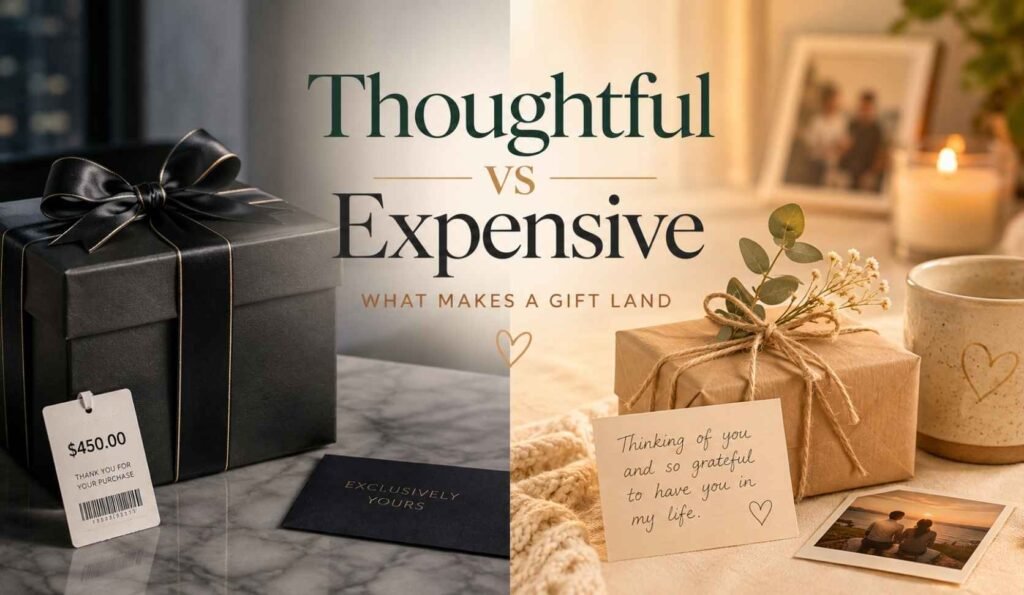
Research found givers expect price to drive appreciation and recipients report it does not. Here is what thoughtful actually means, in four testable parts.
A thoughtful gift beats an expensive one, and there is published evidence rather than just a nice sentiment behind that. Across three studies, Flynn and Adams (2009) found that gift-givers expected a positive relationship between how much they spent and how appreciated the gift would be, while recipients reported no such association at all. Price is a variable givers optimize for and recipients did not report responding to. What they do respond to is evidence that you were paying attention.
That is the whole answer, but “be thoughtful” is useless as an instruction, so the rest of this page turns it into something you can actually check. If you want the full decision method behind it, start with our guide to how to choose the perfect gift.
A note on scope: the norms described here are US gift-giving conventions. Expectations around price, cash and formality vary sharply by culture and by family.

Be precise about what the study says, because the internet has flattened it into “price does not matter.”
Flynn and Adams (2009), published in the Journal of Experimental Social Psychology, found an asymmetry between two groups. Givers assumed that a more expensive gift conveys a higher level of thoughtfulness, and expected appreciation to rise with price. Recipients, asked about gifts they had actually received, reported no such link between what a gift cost and how much they appreciated it.
That is a finding about a reported association, not a proof that money is irrelevant in every situation. There are real cases where the amount carries meaning, and we get to them below rather than pretending they do not exist. But for the ordinary birthday, holiday or thank-you gift that most of this worry is about, the anxiety about looking cheap is aimed at a variable the recipient did not report tracking.
Every gift guide tells you to be thoughtful and none of them define it. Here is a working definition in four parts. A gift that passes all four lands. A gift that fails two usually does not, whatever it cost.
The gift proves you noticed something. Not “she likes cooking,” which anyone who has met her knows, but the specific complaint about the pan that does not sit flat, or the cookbook author she keeps quoting, or the ingredient she cannot get locally.
Evidence of attention is the difference between a gift that says “I know your category” and one that says “I was listening in March.” Generic knowledge is cheap and reads as cheap. Specific knowledge cannot be bought at any price, which is precisely why it outperforms budget.

A beautiful object for a life the person does not have is a burden politely received. A serving platter for someone who never hosts. A hardback for someone who reads on a phone during a commute. Something large for someone in a small apartment mid-move.
Fit means the gift survives contact with their real week. Ask where it will physically go, when they would use it, and whether using it requires them to change a habit. If it needs them to become a slightly different person first, it is a gift for the person you imagine rather than the one you have.
Effort should be legible in the gift itself, not in the story you tell about it. A note explaining why you chose this particular thing does that work in two sentences. So does a small detail only the two of you would recognize.
What does not work is narrating the trouble you went to. “I drove to three stores” transfers the cost of the gift onto the recipient, who now owes you gratitude for the errand rather than pleasure in the object. Let the gift carry the evidence and stay quiet about the logistics.
The best gifts leave the recipient with something and nothing else. A gift that visibly outstrips the relationship, or outstrips what they can return, hands them a debt. They now have to match it, explain why they cannot, or feel awkward every time they see it.
This is the part that most often turns an expensive gift into a bad one. Generosity that lands as pressure is not generosity yet. If you can imagine the recipient calculating what they now owe you, the gift is too big for where the relationship currently is.

Three failure modes, none of which apply to a modest gift.
It creates a reciprocity debt. As above. The bigger the gap between what you gave and what the relationship supports, the more the gift asks of them.
It reads as substitution. A high price with no personal detail can read as a payment rather than a present, especially in relationships that have felt neglected. The recipient’s honest reaction is that you spent money instead of spending attention, and they are often right.
It sets a floor. Expensive gifts recalibrate expectations. Next year the same gift will not register, because it is now the baseline. A modest, specific gift is repeatable for decades. An escalating one is not, and everybody in it eventually feels trapped.
None of this means spending is wrong. It means price is doing less work than you assume, and can quietly do damage.

Honesty requires naming the exceptions, because a page that says price never matters is as unhelpful as one that says it always does.
Where the gift is a shared big-ticket item. When several people combine for one substantial thing, your contribution is a real number and it is visible to the group. That is a coordination question, not a thoughtfulness question.
Where cash or an amount is the convention. In many US contexts, weddings, some religious and cultural occasions, and certain family traditions carry a genuine expectation about the amount rather than the object. The convention is the gift.
Where a very low tier reads as a message. Underspending is a real signal too, and almost no guide admits it. A conspicuously slight gift to someone who is close to you, at an occasion that clearly matters, can read as distance. The fix is rarely more money. It is more specificity, plus a tier that matches the relationship.
We work through the tiering in detail in how much to spend on a gift, by relationship and by occasion weight.
Four questions. Run them in this order and you will know within a minute.
A gift that answers all four is thoughtful in the operational sense, regardless of what it cost.
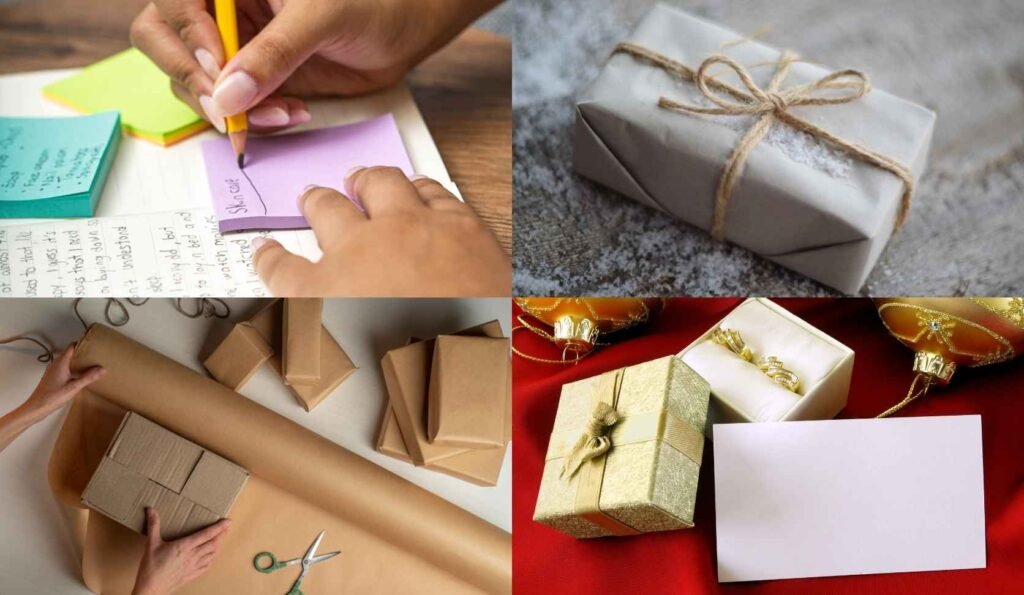
Presentation carries more weight than the price gap it is covering.
Write the note first. Two sentences: why this, why them, why now. This single habit does more for perceived thoughtfulness than doubling the budget, because it puts the evidence of attention where it cannot be missed.
Be specific rather than premium. The exact tea they drank on a trip beats a nicer tea they have no history with. Specificity is the currency here.
Handle the handover. Wrapping, timing and a moment of undivided attention are free and they change how the object is read. A rushed handoff at the door undersells a good gift; a considered one carries a small one.
Pair, do not upgrade. A small object plus a note plus a shared plan reads as far more considered than one larger object on its own. For a worked example on a real occasion, see our graduation gift ideas guide.
Do not undo it, and do not announce it. Removing a gift after the fact is more awkward than the overspend.
Instead, close the obligation gap on purpose. Say clearly, at the handover, that there is nothing to match here and you wanted them to have it. Naming it is the whole fix, because the discomfort comes from an unspoken calculation, and one honest sentence retires the calculation.
Then adjust next time rather than this time. Tier down and specify up. If the overspending is a pattern rather than one occasion, the problem is the budget process, not the gift, and it is worth reading why gift-giving feels so stressful, which covers where that loop comes from.
Not according to the available research. Flynn and Adams (2009), in the Journal of Experimental Social Psychology, found that givers expected appreciation to rise with the amount spent, while recipients reported no association between a gift’s price and how much they appreciated it. The variable givers budget around is not the one recipients reported responding to.
Four things, and they are checkable. It shows evidence you noticed something specific, it fits the life they actually live, the effort is visible in the gift rather than narrated afterward, and it does not leave them owing you anything. A gift that passes all four reads as thoughtful whatever tier it sits in.
The concern is far more common than the judgment. Recipients in the Flynn and Adams work reported no link between price and appreciation, so the risk is mostly imagined. Where a modest gift does fall flat, the cause is usually that it was generic rather than that it was inexpensive, and specificity fixes that at no cost.
Handmade gifts start with a natural advantage on evidence of attention and effort, but they can fail the fit test badly. A handmade object still has to suit the recipient’s actual taste, space and habits. Handmade and well-fitted beats bought and generic; handmade and unwanted does not beat anything.
Write a note explaining why you chose this specific thing for this specific person, choose the exact version tied to something they love rather than a nicer generic one, and give it proper wrapping and an unhurried handover. Specificity and presentation are what read as care, and neither of them costs anything.
Sources